
Separation can be one of life’s most challenging experiences, and understanding what happens next often feels overwhelming. One of the first questions many people ask is, “What does the property settlement process actually involve?”
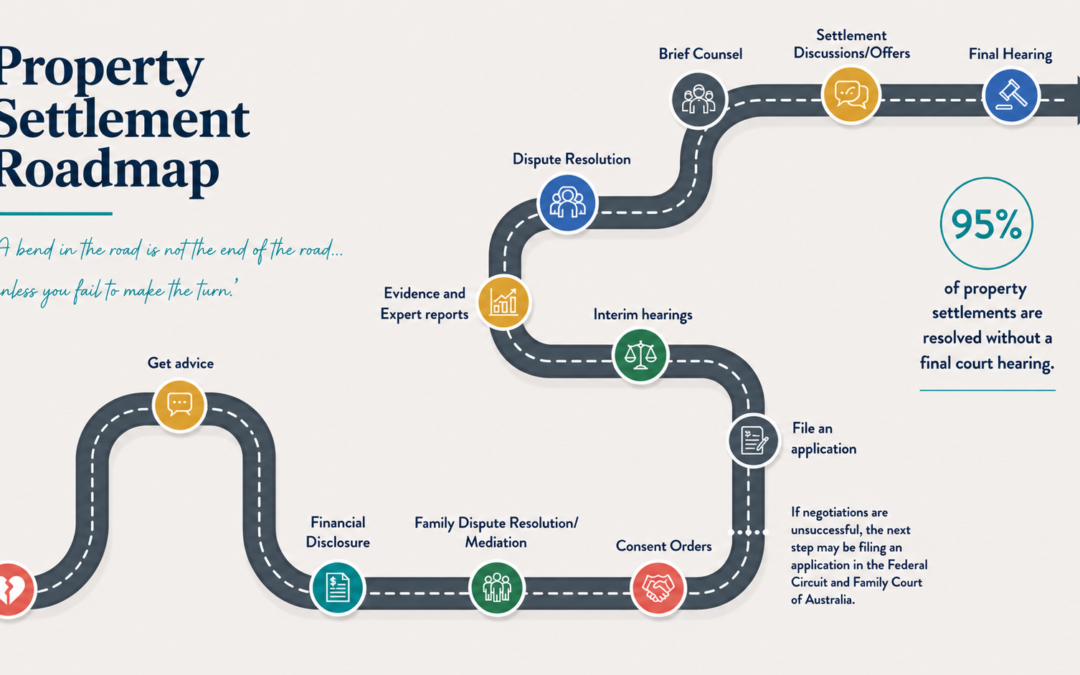
While every family is different, the property settlement process in Australia generally follows a clear pathway. Some matters are resolved quickly through negotiation, while others take a few more turns before reaching an outcome. The important thing to remember is that every step is designed to move you closer to a resolution.
Just as importantly, strict time limits apply to property settlement applications. If you were married, you generally have 12 months from the date your divorce becomes final to commence court proceedings for a property settlement. If you were in a de facto relationship, you generally have 2 years from the date of separation. Missing these deadlines can make it significantly more difficult to pursue your entitlements, which is why seeking legal advice early is so important.
The good news is that around 95% of property settlement matters are resolved without a final court hearing, meaning most people reach an agreement well before a judge is required to make a decision.
This guide explains the typical stages of a property settlement so you know what to expect, what each step involves, and where there are opportunities to resolve your matter along the way.
Is Every Property Settlement the Same?
Every separation is different. Some couples are able to reach an agreement after exchanging financial information and attending mediation. Others may require court proceedings before a resolution is reached.
The roadmap above doesn’t mean every matter will pass through every stage. Instead, it shows the possible pathway your matter may take if negotiations become more complex.
Importantly, there are opportunities to settle your matter throughout the process, even after court proceedings have commenced.
Step 1: Get Advice and Understand Your Position
Before making any decisions about dividing assets, it’s important to understand your legal rights and obligations.
Obtaining legal advice early can help you:
- Understand your likely entitlements
- Learn how the law applies to your circumstances
- Avoid costly mistakes or informal agreements that may not protect you
- Develop a strategy that aligns with your goals
Many people assume they know what they’re entitled to based on stories from friends or information they’ve read online. Every property settlement is different, and early advice from a Family Law Solicitor can help you make informed decisions from the outset.
Don’t Miss the Time Limits for Property Settlement
One of the biggest reasons to seek legal advice early is that strict time limits apply to property settlement applications. If you miss these deadlines, you may lose your right to ask the Court for a property settlement unless you obtain the Court’s permission to proceed out of time. This can be difficult, expensive and is not guaranteed.
Generally:
- Married couples have 12 months from the date their divorce becomes final to commence property settlement or spousal maintenance proceedings.
- De facto couples have 2 years from the date of separation to commence property settlement or spousal maintenance proceedings.
Even if you’re negotiating amicably, it’s important to keep these limitation periods in mind. Waiting until the deadline is approaching can place unnecessary pressure on negotiations and may leave you with fewer options if an agreement can’t be reached. Seeking legal advice early allows you to understand your rights, preserve your options, and ensure important deadlines aren’t missed.
Step 2: Exchange Financial Disclosure
Property settlements are built on transparency. Under the Family Law Act, both parties have an ongoing duty to provide full and frank financial disclosure.
This includes sharing information about:
- Assets (property, savings, vehicles, investments)
- Liabilities (loans, credit cards, mortgages)
- Superannuation
- Income and financial resources
Complete disclosure allows everyone to negotiate from the same set of facts. If information is withheld, negotiations can stall, legal costs may increase, and the Court can impose significant consequences.
Step 3: Try to Reach Agreement
Once both parties understand the financial position, the next step is often negotiation or mediation.
Family Dispute Resolution (FDR) or mediation provides an opportunity to discuss settlement options with the assistance of an independent mediator.
The benefits include:
- Lower legal costs
- Faster resolution
- Less conflict
- Greater control over the outcome
Many property settlements are successfully resolved during this stage without the need to commence court proceedings.
Step 4: Make Your Agreement Legally Binding
If you reach an agreement, it’s important to formalise it legally.
This is typically done through:
- Applying for Consent Orders, or
- Entering into a Binding Financial Agreement, where appropriate
Simply reaching a verbal agreement or dividing assets informally may not prevent future claims. Formalising the agreement provides certainty and legal protection for both parties.
Step 5: If You Can’t Agree, Court May Be Necessary
If negotiations are unsuccessful, the next step may be filing an application in the Federal Circuit and Family Court of Australia. Starting court proceedings does not mean your matter is destined for trial.
Instead, it provides a structured process to help move the matter towards resolution while allowing the Court to make decisions if agreement cannot ultimately be reached.
Step 6: Interim Hearings Along the Way
Some matters require urgent issues to be determined before the final property settlement. These are dealt with through interim hearings.
Examples include:
- Preserving assets from being sold
- Interim financial support
- Access to funds for legal costs
- Other urgent financial issues
Interim orders help maintain stability while the overall matter continues.

Step 7: Building the Evidence and Expert Reports
As the matter progresses, each party gathers evidence to support their position.
This may include:
- Financial records
- Property valuations
- Business valuations
- Superannuation information
- Expert accounting reports
- Evidence about contributions made during the relationship
The complexity of this stage will depend on the nature of the asset pool. Matters involving businesses, farms, family trusts or significant investments often require expert evidence.
Step 8: Ongoing Dispute Resolution
Commencing court proceedings does not stop negotiations. In fact, the Court actively encourages parties to continue resolving their dispute through:
- Negotiation
- Mediation
- Conciliation conferences
- Settlement conferences
Many matters settle during this stage, sometimes only weeks or even days before the final hearing.
Step 9: Preparing for Trial
If settlement still cannot be reached, your legal team will prepare a brief to counsel.
This includes:
- Court documents
- Evidence
- Witness material
- Expert reports
- Legal submissions
- Case Strategy
Your barrister will then represent you at the final hearing. Fortunately, only a small percentage of matters proceed this far.
Step 10: Settlement Discussions and Offers
As more information becomes available, settlement discussions often become increasingly focused.
This may involve:
- Making formal offers
- Considering counter-offers
- Responding strategically
- Assessing legal risks
- Evaluating the likely outcome if the matter proceeded to trial
Experienced legal advice during this stage can help you weigh the risks and benefits of accepting or rejecting an offer.
Step 11: Final Hearing (if required)
If all attempts at settlement have been exhausted, the matter proceeds to a final hearing before a judge.
At the hearing:
- Each party presents their evidence
- Witnesses may be cross-examined
- Legal submissions are made
- The judge considers all of the evidence before making a decision.
Unlike television courtrooms, the judge will not usually deliver a decision on the day of the hearing. Instead, they will reserve their judgment and provide a written decision at a later date. While timeframes can vary depending on the complexity of the matter and the Court’s workload, judgments are typically delivered within approximately three months of the final hearing.
Can We Still Settle After the Final Hearing?
Yes. Even after all of the evidence has been presented and the hearing has concluded, parties can continue negotiating while waiting for the judge’s decision.
If an agreement is reached before judgment is delivered, the parties can notify the Court and, in many cases, finalise the matter by consent. This allows the parties to retain control over the outcome rather than having a decision imposed by the Court.
This is another reason why settlement discussions remain worthwhile throughout the entire property settlement process. There is almost always an opportunity to resolve the matter until the Court has handed down its final judgment.
How Does the Court Decide a Property Settlement?
Whether your matter settles through negotiation or proceeds to court, the same legal principles generally apply.
The Court will generally consider four key questions:
1. What property, liabilities and financial resources exist?
The Court identifies and values the total asset pool.
2. What contributions has each party made?
This includes:
- Financial contributions
- Non-financial contributions
- Contributions as homemaker or parent
- Contributions made before, during and after the relationship
3. What are each person’s current and future circumstances?
The Court considers factors such as:
- Age
- Health
- Income earning capacity
- Care of children
- Financial resources
- Other relevant future needs
4. Is the proposed outcome just and equitable?
Ultimately, the Court considers whether the proposed division is fair in all of the circumstances.
How Long Does a Property Settlement Take?
There is no standard timeframe. Some straightforward matters resolve within a few months.
More complex matters involving businesses, trusts, significant assets or court proceedings may take considerably longer. The earlier both parties obtain legal advice, provide complete financial disclosure and genuinely engage in negotiations, the more efficiently the process can usually progress.
Understanding the Process Makes It Less Overwhelming
The property settlement process may seem complex when you’re experiencing separation, but understanding the roadmap often makes the journey far less daunting.
Whether your matter resolves through negotiation, mediation or, in some cases, the Court, knowing what lies ahead allows you to make informed decisions at every stage.
If you’ve recently separated, don’t wait until deadlines are approaching. Early legal advice can help you understand your entitlements, protect your position and ensure important limitation periods aren’t missed.
Need advice about your property settlement?
Contact Orman Solicitors to arrange a confidential consultation with one of our experienced family lawyers. Early advice can often save significant time, stress and legal costs later in the process.
Frequently Asked Questions about Property Settlements
Do I have to go to Court for a property settlement?
No. Approximately 95% of property settlement matters resolve without a final court hearing. Negotiation and mediation successfully resolve most disputes.
What happens if my former partner won't disclose their finances?
Both parties are legally required to provide full and frank financial disclosure. If someone refuses, the Court has powers to compel disclosure and may make costs orders or draw adverse inferences against that party.
Can we settle after court proceedings have started?
Yes. In fact, many matters settle after court proceedings commence. The Court encourages parties to continue negotiating throughout the process.
Are Consent Orders legally binding?
Yes. Once approved by the Court, Consent Orders are legally binding and enforceable.
Can we simply divide everything ourselves?
While you can reach your own agreement, it is important to have that agreement properly documented. Without legally binding documentation, either party may be able to make future claims against the other.
Read Next: Common Property Settlement Mistakes to Avoid

Belinda Doyle
Senior Solicitor
Belinda is an Accredited Specialist in Family Law who is passionate about helping people navigate life’s most challenging transitions with confidence and clarity. With over a decade of experience in family law, Belinda provides practical, compassionate advice tailored to each client’s unique circumstances. She also holds a Master of Laws majoring in Family Law from The College of Law Australia.
Disclaimer: The content presented in this article is offered for informational purposes and should not be construed as legal advice or a substitute for professional guidance. If you have questions or require legal assistance, we strongly recommend consulting with a Solicitor to address your individual circumstances.